The rear-landing-gear assault plan for Flight 127
All the Old KnivesThe rear-landing-gear assault plan for Flight 127 was an emergency proposal to storm the hijacked aircraft through its undercarriage before the hijackers’ deadline expired. Based on information from a passenger aboard Royal Jordanian Flight 127, it offered a possible route to intervene but carried a stated risk of killing some passengers; a later message exposed the route to the hijackers’ surveillance and prompted its abandonment. The plan’s brief life turns on a stark calculation: whether a dangerous rescue attempt was less likely to end in mass death than waiting for the hijackers’ demands to be met.
Crisis and Intelligence
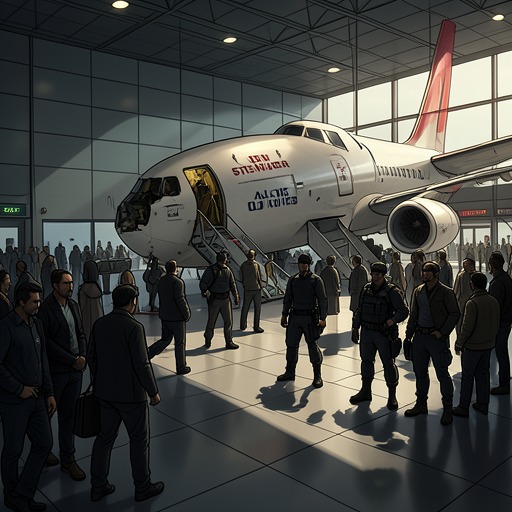
The proposal arose after Flight 127 landed in Vienna from Amman. The flight had carried 120 passengers and crew in an Airbus 319, and the hijacking began immediately after touchdown. One of the hijackers, Suleiman Wahed, shot a stewardess, Raniyah Haddadin, when she stood and asked him to sit down. The four attackers were identified as members of Aslim Taslam. Their demand, conveyed in calls to the control tower and to ORF, was the release of five prisoners—two in Austria and three in Germany—within forty-eight hours. The briefing also reported seventeen Americans aboard, though that count was still being checked.
Five hours after the hijacking began, Ahmed Najjar sent a text to an emergency Langley number, which was forwarded to the Vienna team. Ahmed was travelling on a Lebanese passport, but the intelligence officers identified him as a Central Intelligence Agency courier. His message described four attackers with two guns, children in first class, and a division of the other passengers by seating area: Muslims to starboard and the rest opposite. He was aft among the Muslim passengers. Two women were in critical condition, water was running out, and the loss of power meant there were no cameras inside the cabin. Ahmed’s proposed response was an assault through the rear undercarriage.
Proposal and Objections
The plan entered the discussion as a contingency, not as an operation already under way. Owen Lassiter framed the choice in urgent terms: if Austria and Germany refused the demands, the plane would have to be stormed before the deadline, because otherwise everyone aboard might die. The American officers were not going to storm it themselves; their stated role was to advise the Austrians. The distinction mattered, but it did not remove their responsibility for recommending a course of action.
Henry Pelham endorsed Ahmed’s suggestion. He argued that an undercarriage entry had been attempted before and that, although some passengers might be killed, this was preferable to losing everyone. His reasoning set a limited, foreseeable cost against the threatened total loss of life. The evidence records the proposal and its rationale, not an Austrian decision to carry it out; the assault should therefore be understood as a recommendation under consideration, not a rescue that took place.
Celia Favreau raised a different operational risk. ORF television cameras were already positioned at the fence, she pointed out, and the hijackers had contacted the media because they wanted observers outside the aircraft. Even if the Austrians cordoned off the reporters, she reasoned, the broadcasters would speculate about why they had been pushed back. News of preparations to enter the plane could thus reach the hijackers indirectly. Her objection widened the calculation beyond the physical danger of the route: secrecy was part of the plan’s viability, and the scene outside the aircraft made secrecy uncertain.
The Plan Is Withdrawn
Later, after a fruitless discussion and Henry’s absence from the office, another message from Ahmed arrived. At ten-thirty he told the team to scratch the attack plan: the hijackers had a camera on the undercarriage. He did not know how they had installed it, but judged it clear that they knew what they were doing. He warned that the situation was very serious and recommended giving them what they wanted, or everyone would end up dead.
The new intelligence reversed the proposal’s central advantage. Ahmed had suggested the undercarriage because the lack of power meant there were no cameras inside; the later report established that the exterior approach was nevertheless watched. The intended point of entry was not a blind spot. The officers could only speculate about how the camera had been attached. Ernst Pul suggested that airport security in Amman might have been compromised and that a baggage loader could have placed a remotely operated camera on the aircraft’s hull. This was a suspicion, not a confirmed account of who installed it or when.
The revised message did not describe an assault or its outcome; it explicitly cancelled the proposed approach and urged compliance with the hijackers’ demands. The evidence does not establish whether the governments accepted that recommendation, what happened at the deadline, or whether any other rescue plan followed. What it does establish is how rapidly the balance of risk changed when the team learned that the apparent access route was under surveillance.
Significance
The episode makes the assault plan a test of decision-making under pressure rather than a straightforward tactical solution. The threatened deadline, the dwindling water, two critically injured women, and the presence of children aboard gave the team reasons to act quickly. Yet the available information was incomplete: the passenger count was still being verified, the camera’s installation was unexplained, and a visible operation risked alerting the hijackers. Each new fact altered what could responsibly be advised.
The plan also anticipates the institutional logic made explicit later in Henry Pelham’s claim that suspected traitors cannot be prosecuted and that the Agency’s logic must be followed to its conclusion. That later claim concerns Henry’s decision about Celia, not the assault proposal itself, but both scenes present life-and-death choices in terms of constrained options and anticipated consequences. In the Flight 127 crisis, the undercarriage proposal is first defended as the lesser danger and then discarded when its premises fail. Its significance lies in that reversal: urgency can justify considering lethal risk, but it cannot make an exposed plan safe.